


Abstract
This study seeks to determine how relationship satisfaction is affected by trust, intimacy, and communication in college students. It was hypothesized that relationships with higher levels of trust, intimacy, and communication would report higher levels of relationship satisfaction. The participants consisted of 259 University of Pittsburgh students older than 18 years old who have been in a relationship within the past year. Participants completed a Qualtrics survey in which they read statements related to trust, intimacy, communication, mental health, and relationship satisfaction, and then select on a Likert scale how much they resonate with the statement, from “strongly disagree” to “strongly agree.” The study reported multiple main effects and interactions. Those who reported worse trust, intimacy, and communication also tended to have higher relationship satisfaction. Furthermore, an interaction between communication and mental health on relationship satisfaction revealed that those reporting low communication levels and better mental health had significantly lower relationship satisfaction than those with high communication levels and stronger mental health. Additionally, those in committed relationships had higher communication levels than those in casual dating and hookup relationships. Future studies should focus on replicating this study’s procedure with validated scales, as well as exploring what virtues college students value.
Keywords: communication, trust, intimacy, relationship satisfaction, mental health, college, relationships
The Surprising Effects of Trust, Communication, and Intimacy on Relationship Satisfaction in College-Age Individuals
In 1988, researchers at Texas Tech University developed the Relationship Assessment Scale (RAS), which was designed to replace previous measures of relationship satisfaction that were only applicable to married couples rather than all types of romantic unions (Hendrick, 1988). The RAS is composed of 7 items rated on a Likert scale that assess levels of love, problem-solving, and expectations in a relationship, and is said to be generalizable to married and unmarried couples, as well as dating couples and non-heteronormative couples. For as long as traditional attitudes towards relationships remained culturally dominant, the RAS served as a sufficient, brief measure of relationship satisfaction.
However, the world of dating, especially among younger populations, has evolved dramatically since the turn of the century (Heldman & Wade, 2010). Where relationships used to be defined by monogamy and exclusive dating, today many younger individuals have defied these traditional dating norms by destigmatizing and embracing “hook-up culture” as well as casual dating, known as “situationships” (Bradshaw, Kahn, & Saville, 2010). As the definition of a relationship continues to morph and encompass a larger variety of romantic and sexual unions, research must be conducted on what factors affect satisfaction levels within these relationships. For this reason, the current study seeks to analyze how certain factors – trust, communication, and intimacy – affect one’s satisfaction within a relationship.
Relationship satisfaction is crucial in maintaining a high-quality, healthy relationship (Markman et al., 2010). Most research on relationship satisfaction and its implications for a relationship has been conducted on married, heteronormative couples. This research shows that among a handful of other variables, such as emotional distress or age, one’s level of satisfaction with their marriage is a strong predictor of a relationship’s eventual dissolution (Røsand et al., 2013). In other words, married couples who report a lower level of satisfaction in their relationship are more likely to be divorced within the first five years of marriage than reportedly satisfied couples. Based on this pattern, we hypothesize that those who report having higher rates of satisfaction with their primary partner are more likely to still be romantically and/or sexually involved with said partner at the time of taking our survey.
Trust and Relationship Satisfaction
Plenty of previous research has examined the potential connections between trust and relationship satisfaction. In a survey distributed amongst 42 Canadian couples who were either married, cohabitating, or exclusively dating, researchers determined that increased levels of trust were positively correlated with self-reported measures of closeness (Rempel, Holmes, & Zanna, 1985). When prompted to rank the most important aspects of trust, couples reportedly valued being able to have faith in one’s partner more than their partner’s dependability or consistency. Since the study included couples who were both married and dating, these findings may be more generalizable to today’s relationships than if it had been conducted with just married couples. For this reason, it would be logical to posit that those college students who were in a relationship within the past year and report high levels of trust with their primary partner will likely still be in said relationship.
Other studies have reaffirmed this apparent relationship between trust and relationship satisfaction. In one study, researchers asked both individuals in a heteronormative, monogamous relationship to self-report their levels of dyadic trust and relationships satisfaction through a short survey (Fitzpatrick & LaFontaine, 2017). After collecting the data, researchers found that higher female relationship satisfaction was significantly predicted by both high male and female dyadic trust. Interestingly, while increased male relationship satisfaction was significantly associated with increased male relationship satisfaction, the relationship between male relationship satisfaction and female dyadic trust was nonsignificant. Due to these results, we expect to see that male-identifying and female-identifying participants who report high levels of trust within their relationship will also report being highly satisfied with their relationship. Despite the study only including male-female couples, we also expect that the correlation between trust and satisfaction will persist even when the relationship is non-heteronormative.
Communication and Relationship Satisfaction
Communication is another commonly studied variable in relationship studies. Previous research has suggested that the quality of communication skills between soon-to-be-married couples could predict the level of distress and the likelihood of divorce in the marriage five years later (Markman et al., 2010). The longitudinal study, which involved 210 couples, used self-reported measures as well as video-recorded communication tasks to grade couples on the prevalence of positive and negative communication. Then, the researchers followed up with the couples five years later to reevaluate the quality of communication, measure the self-reported levels of distress, and assess marital status. Ultimately, the data trends showed that couples who reported higher levels of positive communication and lower levels of negative communication in the premarital and post-marital stages tended to report lower levels of distress in the relationship, and were less likely to be divorced. Since divorce has been shown to be representative of an overall lack of marital satisfaction (Gigy & Kelly, 1993), then it could be reasonably hypothesized that positive communication may be predictive of higher relationship satisfaction.
The relationship between communication and relationship quality is supported by similar studies. In a study which utilized both behavioral observation and self-reported measures of communication between married couples, Johnson et al. (2005) reported that married couples who displayed solution-oriented communication in problem-solving conversations were more likely to report unanimous high relationship satisfaction. Furthermore, the researchers noted that couples who displayed more positive dispositions, as opposed to generally negative or aggressive dispositions, during problem-solving conversations reported higher relationship satisfaction.
Another study by Bloch, Haase, and Levenson (2013) examining heterosexual married couples in similar experimental conditions further reaffirms the direct relationship between communication and satisfaction. In this experiment, the researchers specifically focussed on measuring the emotion regulation skills of individuals in relationships to compare them to self-reported measures of marital satisfaction. Ultimately, the data showed a significant correlation between successful regulation of negative emotions during arguments and dyadic relationship satisfaction.
Each of the aforementioned studies on communication and relationship satisfaction seemingly reaffirm each other’s conclusions. However, their nature as studies conducted in a laboratory setting could raise potential limitations if the participants feel as if they need to act or respond a certain way based on the perception of being monitored and evaluated. In an attempt to determine whether or not productive communication is related to relationship satisfaction in non-laboratory settings, Ryjova et al. (2024) conducted a study in which 121 couples were consensually vocally monitored within their own homes over the course of 24 hours. The study utilized a smartphone that was programmed to randomly record audio throughout the day for a total of 11 hours. Each couple was asked to spend at least 5 hours of the day together, and were reportedly entirely unaware as to when the phone began recording. Before, during, and after this day of recording, each spouse was asked to submit a self-report survey that measured their individual satisfaction with the relationship and their perceptions of their own and their partners’ communication skills.
The results from Ryjova et al. (2024) study displayed similar results to the previous studies on communication and relationship satisfaction. Partners who displayed more frequent and fervent aggression towards each other, as well as those who frequently withdrew from conversations, were more likely to report lower satisfaction with their relationship as a whole. After following up a year later, these dissatisfied couples were significantly more likely to have broken up since the day of recording. Conversely, couples who displayed more comforting dispositions reported higher levels of satisfaction before, during, and after the day of recording, and were less likely to have ended the relationship a year later. As the researchers write, “warmth and playfulness offered protection against relationship dissolution” (Ryjova et al., 2024). After considering the above research on the effects of communication in a relationship in laboratory and naturalistic settings, we expect to see that college couples who report higher levels of effective communication will report significantly higher levels relationship satisfaction, and will also be more likely to indicate that they are still actively involved in the relationship at the time of taking the survey.
Intimacy and Relationship Satisfaction
Although intimacy is often thought of as the physical or sexual aspect of a relationship, many couples express intimacy in a variety of ways. Timmerman (1991) defines intimacy as “a quality of a relationship in which the individuals must have reciprocal feelings of trust and emotional closeness toward each other and are able to openly communicate thoughts and feelings with each other.” Different categories of intimacy could include emotional, social, sexual, intellectual, and recreational (Greeff & Malherbe, 2001).
Greeff & Malherbe (2001) sought to determine how different types of intimacy in a marriage can affect the partners’ marital satisfaction. To explore this relationship, the researchers analyzed the results of a mail-in survey from 65 couples that asked each participant to privately self-report measures of intimacy and satisfaction. The primary finding of this study was that the experience of all types of intimacy in the relationship strongly predicted the satisfaction of married couples; no one form of intimacy predicted relationship satisfaction any more significantly than others. When the different types of intimacy were broken down, men were found to be significantly less satisfied with recreational and sexual intimacy in the relationship, and that women reported having less satisfaction with the social intimacy within their marriage. These findings naturally suggest two hypotheses. First, we expect there to be a much higher incidence of men reporting lower intimacy scores than women overall. Second, we expect that the lower intimacy scores reported by men on average correlate to a lower overall relationship satisfaction score reported by men than when compared to women.
The Current Study
Across all of these studies on traditional relationships, the data heavily indicates that relationship satisfaction is integral to the longevity of a relationship. Relationship satisfaction in married couples seems to be significantly affected by increased levels of trust, effective communication, and intimacy. However, few studies have attempted research on relationship satisfaction within college-age, non-marital unions in the past two decades. The current study seeks to clarify whether trust, communication, and intimacy also significantly predict reported relationship satisfaction levels in college-age romantic and sexual relationships. We hypothesize that partners who report having higher levels of trust, communication, and intimacy will also report higher levels of relationship satisfaction.
Methods
Participants
The sample for this study consisted of 259 participants between the ages of 19 and 25 (M = 19.99, SD = 1.32). All participants voluntarily completed an online Qualtrics survey, and were recruited by members of the research team through social media apps like Instagram and Snapchat, as well as from classes taught by the head researcher. Participants completed the survey without promises of compensation for their time. All participants were current students at the University of Pittsburgh.
Participants identified their gender identities as follows: man (48), woman (167), non-binary (14), queer (5), and prefer not to disclose (1). The sexual orientations of the sample included asexual (4), bisexual (33), heterosexual (149), homosexual (14), pansexual (4), queer (18), questioning (9), other (2), prefer not to answer (26). The racial/ethnic backgrounds of the sample included African American/Black (10), Asian (42), Hispanic/Latino (12), White/Caucasian (170), and Multi-racial/Bi-racial (1). Participants were also asked to identify their year in school: first-year (68), second-year (38), third-year (72), fourth-year (55), and graduate school (2). Participants were asked to best describe their sexual/romantic relationship statuses within 12 months of taking the survey, whether that be a committed relationship (115), casual dating relationship (26), or single (61).
Materials
The survey used to collect the data for this study was made with Qualtrics. The survey begins with a disclaimer stating that the survey is only to be taken voluntarily and only by students at the University of Pittsburgh. Following this disclaimer is a demographics section that asks about the participants’ status as a student at the University of Pittsburgh, as well as their gender identity, sexual identity, age, race/ethnicity, year in college, and their sexual/romantic relationship status within the past 12 months. The survey then asks if the participant could identify at least one month out of the year in which they had a romantic/sexual partner, as well as whether they are still with that partner at the time of taking the survey. All of these demographic questions were multiple-choice, except for the age question, which was fill-in-the-blank.
The independent variables of this study were communication, trust, and intimacy, while the dependent variable was relationship satisfaction. In order to operationalize these variables, the survey was broken up into individual sections based on each of the variables that utilized multiple choice to gauge responses. Each section contained statements which participants would agree or disagree with using a 5-point Likert scale. In order to determine which statements to include in each section, the research team was broken up into groups in class which were assigned one variable of interest from this study. Each group was told to brainstorm 10 to 15 statements for their respective variable that could be answered on a Likert scale. The statements were then submitted to the head researcher, who compiled them in a Qualtrics survey. The research team then reviewed the survey as a group and tested it to determine whether it was cohesive, intuitive, and functional.
The communication section contained nine statements relating to ease of communication, conflict-resolution, active listening, respect, and goal alignment, among others. Each statement was to be answered using a five-point Likert Scale ranging from “strongly agree” to “strongly disagree.”
The trust section consisted of seven statements relating to dependability, supportiveness, honesty, privacy, and social media-related mistrust. Each of these statements was answered using a five-point Likert Scale ranging from “strongly agree” to “strongly disagree.”
The intimacy section contained six statements pertaining to missing one’s partner, excitement upon seeing one’s partner, emotional closeness, consideration, and time spent together. For all of these statements, a five-point Likert scale ranging from “strongly agree” to “strongly disagree” was used to gauge responses.
The relationship satisfaction section consisted of eight statements which were answered using a 5-point Likert scale ranging from “strongly agree” to “strongly disagree.” The questions related to topics such as happiness, future compatibility, sexual satisfaction, self-reported relationship satisfaction, and frequency of problems.
An additional section was added pertaining to mental health so that those who are not in a relationship do not get immediately rejected from the survey. Before the survey was built, mental health was not part of the research question, and thus was not included in any hypotheses prior to piloting the survey. However, mental health scores were still included in the analysis of the data. The mental health section included 9 statements measured on a 5-point Likert scale ranging from “strongly agree” to “strongly disagree.” The questions ranged from optimism, stress management, sleep quality, friends, emotional control, lethargy, and level of enjoyment when in friendly company.
Procedure
The survey was distributed during the spring semester from February 1st to March 1st. The research team distributed the survey through social media apps such as Instagram and Snapchat, or through other electronic means to University of Pittsburgh students. In order to complete the survey, participants were told they must be University of Pittsburgh students and at least 18 years old. Participants were informed that the survey was voluntary and anonymous through a statement at the beginning of the survey. The participants were asked to disclose whether they have been in a sexual or romantic relationship within the past year, before disclosing the nature of that relationship. If participants indicated that they had not been in a relationship in the past year, the survey would skip to the mental health section before ending. If the participants indicated they had been in a relationship within the past 12 months, they were then asked to evaluate their most recent relationship through statements which they were to agree or disagree with. The statements were separated into five distinct categories based on the dependent and independent variables of the study. The survey’s sections were presented as follows: communication, relationship satisfaction, trust, communication, and mental health. After answering these statements, participants were met with a completion message indicating that they had finished the survey and that their responses were recorded.
Results
The descriptive statistics from each survey scale were calculated, including the number of participants who completed each survey scale, the minimum and maximum scores for each scale, as well as the means and standard deviations of the scores from each scale (see Table 1). For most questions in each section, higher scores were indicative of the higher quality of the variable being measured – communication, intimacy, trust, relationship satisfaction or mental health – while lower scores were indicative of a lower quality of these variables in one’s relationship. However, three questions throughout the survey were reverse coded such that a lower score would be indicative of a higher quality of that variable in the relationship. Using R, the scores for these questions were flipped to match the pattern of the other questions in the survey.
Table 1
Means, Standard Deviations, Minimums, and Maximums of Scores from Each Survey Scale
| Survey Scores | |||||
| Scales | N | M | SD | Min | Max |
| Communication | 123 | 36.49 | 6.28 | 12 | 45 |
| Trust | 123 | 28.06 | 4.43 | 13 | 35 |
| Intimacy | 123 | 26.11 | 4.97 | 7 | 30 |
| Mental Health | 123 | 23.85 | 6.83 | 11 | 39 |
| Relationship Satisfaction | 113 | 14.12 | 7.00 | 8 | 40 |
Note. The numbers above indicate the descriptive statistics for each category based on the scores taken from the survey. A higher score on a scale indicates a “better” quality of that virtue within a relationship.
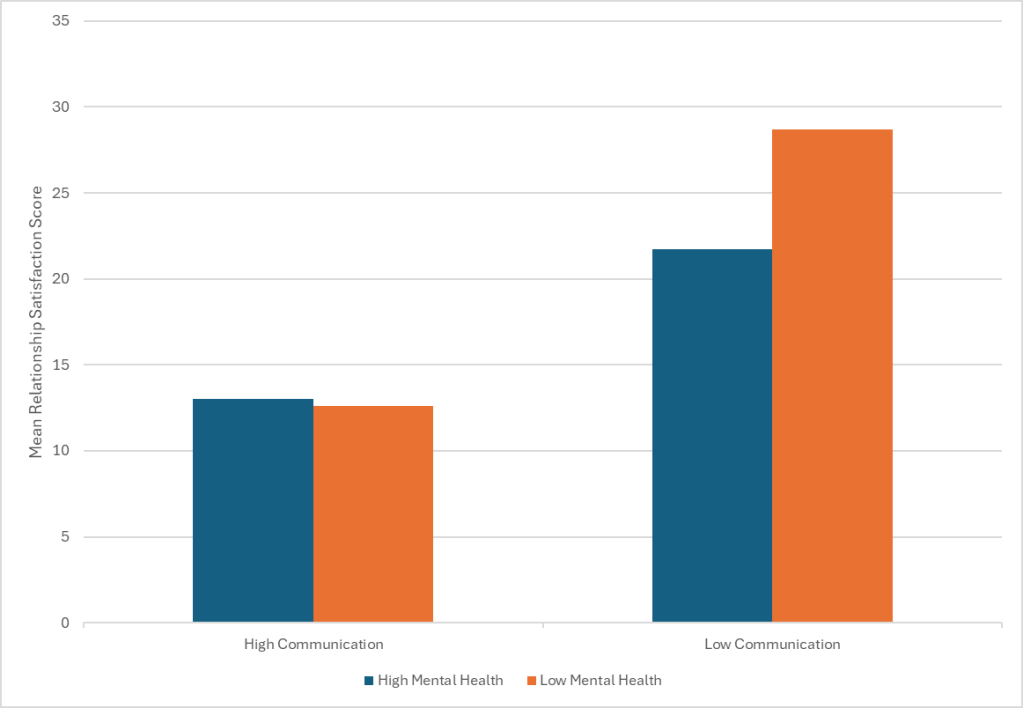
A Two-Way Analysis of Variance (ANOVA) was conducted for communication (low and high) and mental health (low and high) on relationship satisfaction. A main effect for communication was found, F(1, 109) = 51.66, p < .001, η2 = .32; this effect found that participants who reported having poorer communication in their relationship had significantly higher relationship satisfaction, while those who reported better communication reported having lower relationship satisfaction. Furthermore, the ANOVA also revealed a significant interaction between communication and mental health, F(1, 109 = 4.61, p < .05, η2 = .04. See Figure 1. This interaction showed that participants who reported poorer communication in their relationship and better mental health had significantly higher relationship satisfaction levels than participants with better communication and poorer mental health. Additionally, participants who reported poorer communication and poor mental health had significantly higher relationship satisfaction than participants with better communication and better mental health.
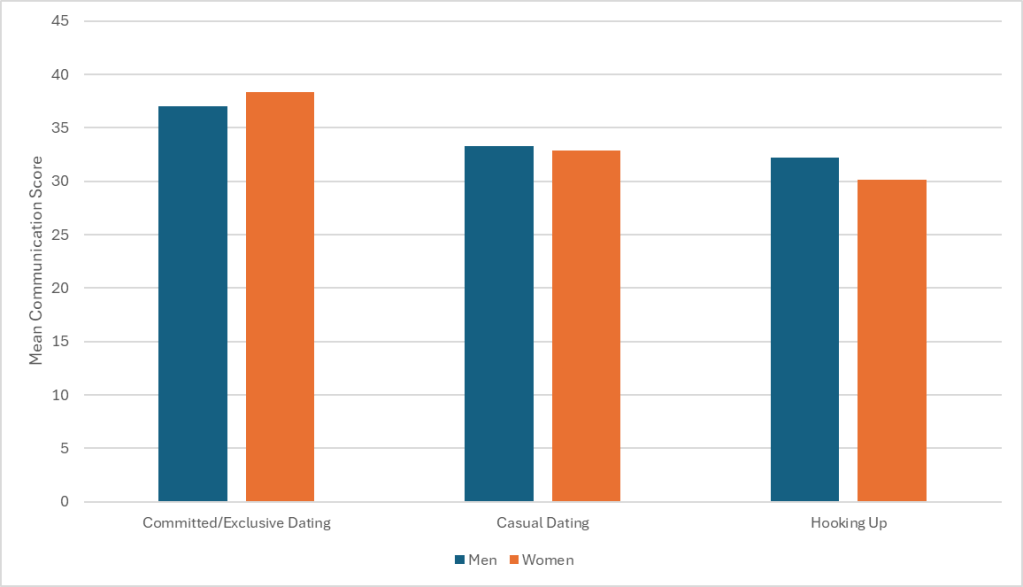
Another Two-Way ANOVA was conducted, this time with relationship satisfaction (committed/exclusive, casual dating, and hooking up) and gender (men and women) on communication. While no interaction was found, a main effect was found for relationship status, F(2,124) = 17.52, p < .001, η2 = .19. See Figure 2. The effect indicated that participants who identified their relationship as committed/exclusive had significantly better communication than participants in both casual dating and hooking up relationships. However, there was no significant difference in communication quality between participants in casual dating relationships and hooking up groups.
Discussion
This study intended to discover whether certain factors, those being communication, intimacy, and trust, affect the satisfaction one experiences within their relationship. The research team hypothesized that participants who reported having better communication, intimacy, and trust levels within their relationship will also tend to report higher relationship satisfaction. No hypothesis was created for the relationship between mental health and relationship satisfaction, since the mental health questions were added during the creation of the survey as a way for participants who identified themselves as single could have some questions to answer without getting immediately kicked out. The results from the survey did not support the hypothesis for any of the three independent variables. Based on the data, participants who reported higher levels of intimacy, trust, and communication tended to report significantly lower relationship satisfaction scores than participants with lower levels of intimacy, trust, and communication. This pattern could have emerged for a number of reasons, ranging from missteps on behalf of the research team, to patterns in the dating lives of college-aged students.
Because there was so much previous research that suggested a relationship between the factors of intimacy, communication, and trust, and the overall satisfaction within a relationship, there is a chance that the trends uncovered in this study may have been a result of researcher error. For example, it could be possible that the survey items used to determine the scores for each scale could have lacked construct validity. The statements that participants were asked to agree or disagree with were brainstormed by the research team within a few weeks of piloting the survey to the public. As such, none of the survey’s scales were tested to ensure that they were actually measuring what they were intended to measure. It could be the case that the scales for the three independent variables measured some other aspect of a relationship that would be more likely to be negatively correlated to relationship satisfaction.
On the other hand, it could just be the case that college-aged relationships simply do not follow the same patterns as all of the research done on communication, intimacy, and trust on relationship satisfaction in married adults. College students are much younger and tend to be more spontaneous and less mature than married individuals. As such, they may not value the typical pillars of a traditional, monogamous relationship experienced by older adults. College students may not see their relationships as something they want to pursue in the future, but rather as something they are merely pursuing for fun while they are young. If this is the case, then perhaps they are less likely to care about commitment, trust, and intimacy within their relationships, since the relationships themselves are not expected to last very long anyways.
The data also revealed an interaction between communication and mental health. Participants who reported poorer communication quality in their relationships and better mental health had significantly lower relationship satisfaction than those with stronger communication quality and poor mental health. Furthermore, those reporting poorer communication quality and poor mental health had significantly higher relationship satisfaction than participants with higher communication quality and better mental health. This data seems to suggest that college-aged couples do not value communication as much as married couples have been shown to value it, but also that mental health could change the degree to which communication is valued in a college relationship.
In order to speculate on why this interaction may have occurred, we must first look at why higher communication scores tended to show lower relationship satisfaction scores than those with lower communication scores. It could be the case that younger individuals, especially those in college, may prefer to have a partner that is less communicative if it means they will have more freedom to explore their adulthood, whereas this sort of freedom would not be as attractive to an older individual. This would result in lower communication scores being paired with higher relationship satisfaction, which is what the data supported. These reasons could explain why higher communication scores, regardless of mental health score, showed lower relationship satisfaction.
The reason why those with lower mental health and low communication may have reported lower relationship satisfaction than those with higher mental health and communication could have more to do with individual perceptions of one’s relationship rather than the true nature of the relationship itself. Those with poorer mental health could be more likely to evaluate their roles in a relationship more harshly. As a result, they may have graded their communication far lower than their partner would have, but they still may have an overall positive view of their relationship. This case would result in low communication scores, but high relationship satisfaction. On the other hand, those with stronger mental health may have more faith in their ability to communicate, thus raising their communication scores, but may view their relationship through a more critical lens because they have higher expectations for their partner due to their own self-respect and higher ego, thus lowering their relationship satisfaction scores.
Furthermore, the reason why high communication and low mental health individuals were less satisfied in their relationship than low communication and high mental health could be due to the aforementioned desires of college students in general. Those with higher communication scores could feel more tired down to their relationship, thus decreasing their mental health and relationship satisfaction. On the other hand, those with lower communication scores may feel more free to do what they desire in a relationship, thus raising their mental health scores and relationship satisfaction.
Another main effect found through the data was for relationship status on communication. This effect found that those in committed or exclusive relationships had higher communication scores than those in casual dating or hooking up relationships. This apparent effect is rather intuitive and straightforward. Individuals in more committed relationships are more likely to spend their time together going on dates, doing fun activities, or merely hanging out, since there is an expectation of devotion between partners. This expectation and the time spent together would naturally result in stronger communication being formed over time. In casual dating or hookup relationships, the expectation for devotion is far less apparent; these relationships are meant to be fleeting and no-strings-attached, and thus there is no motivation to greatly improve communication patterns between partners.
These results create the opportunity for many more studies on college relationships. For starters, this study should be replicated on a larger scale, both on the University of Pittsburgh’s campus and others, before any strong conclusions are drawn from this data. The interactions and effects uncovered in this study are far from intuitive, and thus should be investigated further through repetition. These future studies should use scales with confirmed validity for the measures of communication, intimacy, trust, and relationship satisfaction in order to provide more credibility to their results. If the findings in this study still hold, then that would open the door for a whole series of studies on college-aged relationships, and what factors they value in a partner that may differ from the pillars of an older relationship or marriage. Above all else, this study has shown that college students in relationships differ in many ways from older individuals, and that more studies are necessary to expand our knowledge about how different groups in society value different virtues within their romantic or sexual unions.
References
Bloch, L., Haase, C. M., & Levenson, R. W. (2014). Emotion regulation predicts marital satisfaction: More than a wives’ tale. Emotion, 14(1), 130–144. https://doi.org/10.1037/a0034272
Bradshaw, C., Kahn, A. S., & Saville, B. K. (2010). To Hook Up or Date: Which Gender Benefits? Sex Roles, 62(9–10), 661–669. https://doi.org/10.1007/s11199-010-9765-7
Fitzpatrick, J., & LaFontaine, M. (2017). Attachment, trust, and satisfaction in relationships: Investigating actor, partner, and mediating effects. Personal Relationships, 24(3), 640–662. https://doi.org/10.1111/pere.12203
Gigy, L., & Kelly, J. B. (1993). Reasons for Divorce: Perspectives of Divorcing Men and Women. Journal of Divorce & Remarriage, 18(1–2), 169–188. https://doi.org/10.1300/J087v18n01_08
Greeff, A. P., & Malherbe, H. L. (2001). Intimacy and marital satisfaction in spouses. Journal of Sex & Marital Therapy, 27(3), 247–257. https://doi.org/10.1080/009262301750257100
Heldman, C., & Wade, L. (2010). Hook-up Culture: Setting a New Research Agenda. Sexuality Research and Social Policy, 7(4), 323–333. https://doi.org/10.1007/s13178-010-0024-z
Hendrick, S. S. (1988). A Generic Measure of Relationship Satisfaction. Journal of Marriage and Family, 50(1), 93–98. https://doi.org/10.2307/352430
Johnson, M. D., Cohan, C. L., Davila, J., Lawrence, E., Rogge, R. D., Karney, B. R., Sullivan, K. T., & Bradbury, T. N. (2005). Problem-solving skills and affective expressions as predictors of change in marital satisfaction. Journal of Consulting and Clinical Psychology, 73(1), 15–27. https://doi.org/10.1037/0022-006x.73.1.15
Markman, H. J., Rhoades, G. K., Stanley, S. M., Ragan, E. P., & Whitton, S. W. (2010). The premarital communication roots of marital distress and divorce: the first five years of marriage. Journal of family psychology : JFP : Journal of the Division of Family Psychology of the American Psychological Association (Division 43), 24(3), 289–298. https://doi.org/10.1037/a0019481
Rempel, J. K., Holmes, J. G., & Zanna, M. P. (1985). Trust in close relationships. Journal of Personality and Social Psychology, 49(1), 95–112. https://doi.org/10.1037/0022-3514.49.1.95
Røsand, G.-M. B., Slinning, K., Røysamb, E., & Tambs, K. (2013). Relationship dissatisfaction and other risk factors for future relationship dissolution: A population-based study of 18,523 couples. Social Psychiatry and Psychiatric Epidemiology, 49(1), 109–119. https://doi.org/10.1007/s00127-013-0681-3
Ryjova, Y., Gold, A. I., Timmons, A. C., Han, S. C., Chaspari, T., Pettit, C., Kim, Y., Beale, A., Kazmierski, K. F., & Margolin, G. (2024). A day in the life: Couples’ everyday communication and subsequent relationship outcomes. Journal of Family Psychology, 1–13. https://doi.org/https://doi.org/10.1037/fam0001180 Timmerman G. M. (1991). A concept analysis of intimacy. Issues in mental health nursing, 12(1), 19–30. https://doi.org/10.3109/01612849109058207
 Owen Brader
Leave a comment