

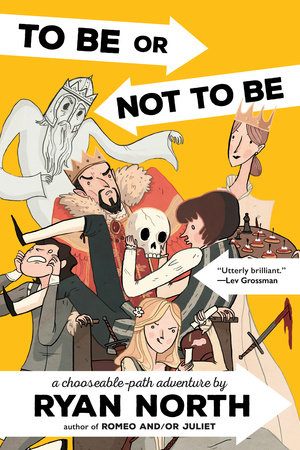
There are very few literary works more widely scrutinized than William Shakespeare’s Hamlet. Published soon after the turn of the 17th century, Hamlet has since become one of the most recognizable facets of English culture. Even those who have never read the play are most certainly familiar with Hamlet’s “To be, or not to be” soliloquy or the image of Hamlet holding a skull while pontificating about the meaning of life. While there have been many reimaginings of the play since its inception, arguably none of these works have elevated Shakespeare’s vision as successfully as Ryan North’s To Be or Not To Be: A Chooseable-Path Adventure. This book, which was written after a wildly successful crowdfunding campaign, puts the reader in Hamlet’s shoes, granting the audience the opportunity to change the outcome of the story as they see fit. While some may see this as a fun, albeit gimmicky reimagining of the original, the Choose-Your-Own-Adventure (CYOA) style truly enhances the central theme established in the play. North’s use of the interactive CYOA medium establishes Shakespeare’s intended message, that perpetual indecision can lead to worse consequences than any decisive action, more effectively than the original play by allowing the audience to influence Hamlet’s actions.
The original story of Hamlet is considered a “revenge plot,” but only by technicality. Where most of these types of narratives feature a gallant hero on an epic journey to avenge personal loss, most often through violence, Hamlet’s titular protagonist experiences entirely different circumstances. There is no thrilling journey to be embarked on, no titillating battles with clear-cut villains, and most importantly, no intrepid hero. In reality, the story explores the human nature of dread and regret; after the ghost of Hamlet’s murdered father appears to his son, the apparition commands Hamlet to take revenge by slaying the killer, King Claudius. Through Hamlet’s constant debate with himself about the moral, emotional, spiritual, and political implications of taking revenge, the theme around the consequences of inaction begins to emerge. Hamlet’s struggle to make a decision ultimately leads to more harm than good. By not acting decisively one way or another, he inadvertently causes the deaths of himself, his mother, his ex-lover, and her entire family.
When first reading the play, the natural reaction to Hamlet’s waffling throughout the story is often one of bewilderment or frustration. Arguably the most unconvincing moment in the play occurs in Act III. Here, Hamlet nearly kills Claudius in a church, only to stop himself and instead utter “And am I then revenged/ To take him in the purging of his soul, when he is fit and seasoned for his passage?/ No./ Up sword, and know thou a more horrid hent” (Shakespeare, 3.3.89-93). In other words, Hamlet refuses to kill Claudius while he is praying because he fears that his soul may go to Heaven, which Hamlet considers to be rewarding. From a third-person perspective, it can be hard to relate to the hesitation that Hamlet expresses in this scene. Considering the fact Claudius orders two characters to murder Hamlet moments before he begins to pray, the postponement of Hamlet’s revenge seems unnecessary and unrelatable to the audience. Especially when considering that this play is Shakespeare’s longest, the dissonance between the audience’s desired decision and Hamlet’s leads some to struggle to connect with the character, and subsequently become frustrated when trying to understand the theme.
In North’s To Be or Not To Be, this problem is remedied by the medium of the CYOA book itself. Unlike a script, where the plot and character actions are set in stone the moment that they are written, a CYOA narrative prompts the reader to make a choice between different actions that ultimately change the direction of the story. In the book Understanding Media: The Extensions of Man, philosopher Marshall McLuhan states that “the personal and social consequences of any medium […] result from the new scale that is introduced into our affairs by each extension of ourselves, or by any new technology” (McLuhan 1). Essentially, McLuhan explains that newer mediums create stronger benefits for the consumer if the medium improves on the abilities of the older mediums in an unprecedented manner.
North’s choice to alter Hamlet’s medium from a play to a CYOA novel epitomizes McLuhan’s ideas. In the era where Shakespeare penned Hamlet, the most common way one could muse about human nature is through analog literature. Since most people were uneducated and thus unable to read, public performances based on these written works were the fastest ways to disseminate the author’s musings. However, today’s world is so seamlessly integrated with the ubiquitous power of interactive technology that audiences can easily assume and explore other perspectives in the form of role-playing games, personal narratives, blogs, and CYOA books. Consistent with McLuhan’s theory, these newer mediums increase the scales of interactivity with the featured narrative, which in turn increases the ability to relate to the narrative’s characters. To Be or Not To Be is so profound because the audience can assume the perspective of Hamlet directly, and thus they feel more attached to the character. Hamlet’s problems are now the reader’s problems, and the consequences of Hamlet’s actions when seeking revenge are now felt on a far more personal level. If Hamlet’s actions seem frustrating in To Be or Not To Be, the readers only have themselves to blame.
The ultimate conflict of To Be or Not To Be remains unchanged from the original work: Hamlet must choose whether or not to kill King Claudius. However, rather than this debate being depicted through prose, North offloads the final decision onto the reader. The first chance the reader has to kill Claudius occurs immediately after the ghost propositions Hamlet for revenge. After Hamlet talks with Horatio about the ghastly paternal visit, North presents the reader with two options: “Say goodbye to Horatio and go kill King Claudius,” or “go home for nappy times” (North 60). The former option’s blunt description of committing murder embodies its decisive nature, while the option to go home and nap is written in frivolous and arguably childish language that parallels the idea that Hamlet may not be ready to take a life so soon. If the reader decides to kill Claudius, Hamlet will wait until the king is drunk to sneak into his castle and take his life. From there, the reader is told that they become the new king of Denmark and their “economic policies are both wise and fair, and [the] country becomes […] prosperous!” before the story comes to a close (North 98). On the other hand, going home to nap will continue the story following the plot of the original play. The message here seems to be crystal clear: decisive action leads to general prosperity, while procrastination leads to further uncertainty. While this point may not be as nuanced as in the play, the intended theme is almost impossible not to discern because North ensures the theme is portrayed through both options. Choosing to take decisive action and killing Claudius will reward the reader and stop any further tragedy from occurring in the story, while refusing to carry out the murder will continue the story, thus exacerbating the risk of undue repercussions.
As the story progresses, North continues to present the reader with the option to either kill Claudius or procrastinate further. In fact, the storyline that follows the closest to Shakespeare’s play features ten different instances where the reader can choose to end the story by successfully taking revenge, living happily ever after as a result every time. After the reader refuses to choose the murderous option three times, North uses the fourth kill opportunity to break the fourth wall to express his disappointment: “You know what? This is not going as well as I had hoped. Tell Ophelia that you don’t know why you are wasting your time either, excuse yourself, and GO MURDER CLAUDIUS” (North 147). The author’s decision to beg the reader to choose to slay Claudius is a clear attempt to both satirize the ridiculous nature of Hamlet’s indecision in the original play, as well as to directly indicate to the reader that this option will complete the story and display his desired theme. After three more refusals, the eighth opportunity presents itself during the aforementioned church scene that often frustrates readers of the play. North acknowledges the absurdity of choosing not to kill Claudius while he is praying, stating “better not kill him now at this perfect opportunity, because it’s really important what happens to him after he dies” (North 63). North addresses this controversial moment in the original story by offering the reader the opportunity to subvert the expected outcome of the scene and reach a satisfying conclusion to the story before things start to go awry. After this moment in the story, each instance of hesitation leads to the death of another innocent character, ultimately leaving four bodies in Hamlet’s wake before he finally works up the courage to take his revenge.
During the last moments of To Be or Not To Be, Hamlet finds himself at the sharp end of a poisoned sword, knowing well that he only has moments left to live. If the reader chooses to kill Claudius at this last chance to take revenge, North satirizes the painfully drawn-out nature of this choice by excitedly writing “YES! YES YOU ARE FINALLY KILLING CLAUDIUS. OH MY GOD FINALLY. OH MY GOD” (North 260). This statement firmly drives home the frustration North holds towards the fact that the reader would choose to belabor the story this much. These moments of fourth-wall breaking and cynicism emphasize how ridiculous it is to not have made a decisive action towards revenge at this point in the story. By giving the readers this many chances to enact revenge, and then poking fun at the readers who choose not to, North attempts to encourage the audience to take the decisive action that Hamlet could not, thus communicating the theme before the reader stumbles into the ending where the titular protagonist loses his life.
North clearly wants the reader to learn the lesson about the dangers of indecision without having to sacrifice Hamlet’s life. In his opinion, and many others who read the original Hamlet, the eponymous character only had to die to fulfill the expectation of a traditional Shakespearian tragedy, not because it was the only way to deliver the message. North seems to believe that by giving the readers the power of choice over Hamlet’s actions, the audience could grapple with the theme that decisive action will lead to less negative consequences than indecision in a much more expedient manner than if the narrative was merely written in a non-interactive medium, such as a play. To Be or Not To Be, while not as introspective or subtle as Shakespeare’s work, ultimately serves as an effective medium to poke fun at the literary world’s most indecisive protagonist in a way that both honors the original story and earnestly exposes some of its most undeniable flaws.
Works Cited
McLuhan, Marshall. “The Medium Is the Message.” Understanding Media: The Extensions of Man, The MIT Press, Cambridge, MA, 1964, pp. 1–18.
North, Ryan. To Be or Not To Be: A Chooseable-Path Adventure. Riverhead Books , 2016.
Shakespeare, William. “Hamlet.” Folger Shakespeare Library, http://www.folger.edu/explore/shakespeares-works/hamlet/read/. Accessed 15 Oct. 2023.
 Owen Brader
Leave a comment